
Latest News
President Tripathi’s Legacy and CELaRAI’s Path Forward
In September 2025, President Satish K. Tripathi delivered his final State of the University address—marking the close of a transformative chapter in UB’s history. Under his leadership, the university rose dramatically in national rankings, forged global partnerships, and launched groundbreaking research initiatives.
CELaRAI is proud to be part of that legacy. In his address, President Tripathi recognized UB’s leadership in AI for public good, noting how faculty across 15 departments are using artificial intelligence to support medicine, cybersecurity, and early learning.
CELaRAI’s Principal Investigator Dr. X. Christine Wang reflected on this milestone:
“It feels like an end of an era,”
“I joined UB in 2003 so my time here almost entirely overlapped with the president’s leadership at UB. I’ve grown a lot over two decades and I’ve also seen the university transformed. To get to where we are today, I’m really proud.”
We carry forward this spirit of innovation and equity—advancing early literacy and responsible AI for the next generation of learners.
CELaRAI Connects with Buffalo Public Schools Families
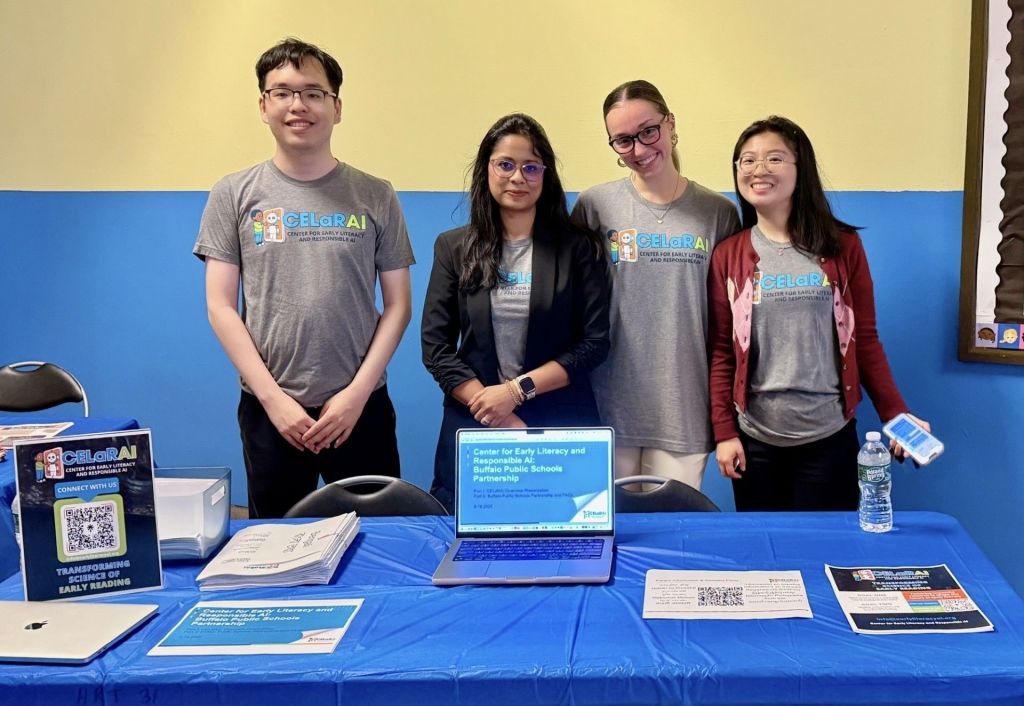
The CELaRAI team recently joined two Buffalo Public School open houses to share updates on our research, demonstrate the AI Reading Enhancer (AIRE) prototype, and engage directly with families and students.
These events offered an opportunity to highlight how equity, literacy, and responsible AI intersect in real classrooms. Through hands-on demonstrations and conversations, we discussed how AI can empower teachers and enhance foundational literacy skills—helping to create personalized, publicly accessible tools grounded in the science of early reading. CELaRAI is committed to building technologies that are designed with educators and communities, not just for them. Connecting with families and students in Buffalo reaffirmed the importance of this mission and the potential of responsible AI to transform early literacy education.
We are deeply grateful to Buffalo Public Schools for welcoming us into their communities and look forward to continuing these partnerships. Special thanks to our UB doctoral students and postdoctoral researcher who represented CELaRAI with expertise and care.

CELaRAI Co-PI Dr. Chris Hoadley Featured on WGRZ-TV
We’re excited to share that CELaRAI Co-Principal Investigator Dr. Chris Hoadley, professor and director of the Institute of Learning Sciences at UB’s Graduate School of Education, was recently featured on WGRZ-TV alongside Dr. Brian Graham, Superintendent of Grand Island Central School District, to discuss the evolving role of AI in education.
“If we want AI to be useful in education, we have to recognize this could go very well or it could go very poorly, and it’s important that everybody in our whole society engages with those conversations about what are good and appropriate uses of AI and what are maybe not what we believe.”
Hoadley emphasizes that AI should be seen as an instructional partner — not a replacement. “Keep it in its place and acknowledge that it can be a useful tool, but it’s a tool,” Hoadley said. “And it’s not a substitute for learning.”
This perspective reflects CELaRAI’s mission to design responsible, human-centered AI that supports early literacy and language development for all learners.
CELaRAI Co-PI Dr. Jaekyung Lee Named UB Distinguished Professor
We’re thrilled to celebrate an incredible milestone for our Co-Principal Investigator, Dr. Jaekyung Lee, who has been named a Distinguished Professor at the University at Buffalo—one of the highest faculty honors awarded by the institution.
This recognition reflects Dr. Lee’s outstanding contributions to research, teaching, and mentorship, as well as his ongoing commitment to advancing innovation and equity in education. His leadership continues to shape the future of responsible AI and early literacy, and we are proud to have him as part of the CELaRAI team.

CELaRAI Co-PIs Publish Read STOP Write Curriculum, Co-Developed With Teachers and Students

Exciting news from CELaRAI Co-PIs John Strong (University at Buffalo) and Laura Tortorelli (Michigan State University)! With support from the Advanced Education Research and Development Fund (AERDF)’s Reading Reimagined program, their team has developed and tested Read STOP Write—a multi-component reading and writing intervention designed for grades 4–9.
Now, the full curriculum is freely available to educators, including lesson plans, slide decks, and student materials co-developed with more than 50 teachers and 1,500 students. Grounded in evidence-based practices, Read STOP Write integrates multisyllabic decoding, vocabulary, fluency, comprehension, and writing instruction to help students engage with complex informational texts and build deep knowledge.
We are proud to celebrate this milestone with our colleagues and partners, and grateful to AERDF for supporting bold, practice-driven innovations that move research into classrooms.
CELaRAI at INTERSPEECH & SLaTE 2025
CELaRAI celebrates Dr. Abeer Alwan and her students for advancing responsible child speech technology on the global stage. At INTERSPEECH 2025 in Rotterdam, Dr. Alwan presented new work on using generative error correction to improve Child ASR and served as an invited panelist on Processing Child Speech. She then delivered a keynote at the SLaTE 2025 workshop in Nijmegen on leveraging ASR and LLMs for automated scoring and feedback in children’s spoken language assessments—pushing the boundaries of ethical, equitable AI in early learning.
Papers & Talks:

Student Research Spotlight: CELaRAI at WOCCI 2025
CELaRAI congratulates student researchers from Dr. Abeer Alwan’s group for three WOCCI 2025 papers that advance inclusive, robust speech technology for children—spanning low-resource speaker verification, age-agnostic systems, and comprehensive benchmarking for Child ASR. These projects reflect our commitment to building ethical AI tools with real-world classroom impact.
G-IFT: A Gated Linear Unit Adapter with Iterative Fine-Tuning for Low-Resource Children’s Speaker Verification
This paper explores a novel adapter architecture to improve speaker verification when working with limited child speech data—critical for ensuring equity in low-resource settings.
An Age-Agnostic System for Robust Speaker Verification
To address variability in child speech due to age differences, this work proposes a system architecture that remains effective across a wide age range—an important step toward more inclusive and scalable ASR systems.
Benchmarking Training Paradigms, Dataset Composition, and Model Scaling for Child ASR in ESP
This benchmarking study evaluates how training strategies and dataset configurations impact model performance in child ASR, offering practical takeaways for future system design and evaluation.
CELaRAI Leaders Highlighted in UB–JAGGAER Collaboration
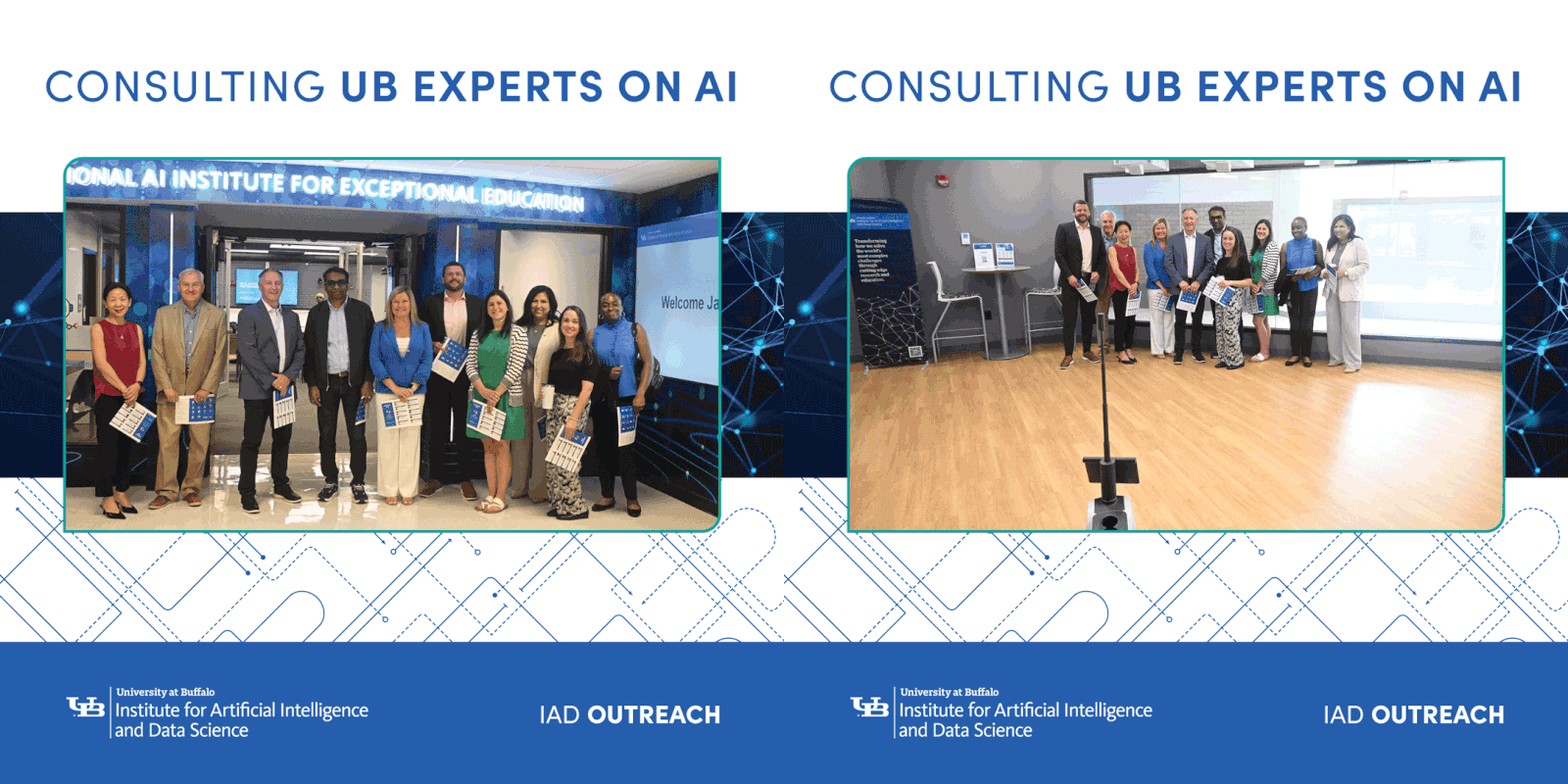
We’re proud to see CELaRAI leaders Dr. X. Christine Wang (PI) and Dr. Jinjun Xiong (Co-PI) featured in UB’s recent collaboration with JAGGAER, SUNY’s strategic eProcurement partner. Their expertise in responsible AI, early childhood education, and data science reflects CELaRAI’s mission to advance equitable, research-driven approaches to AI in education. Hosted at UB’s National AI Institute for Exceptional Education, the strategic meeting explored how UB’s cutting-edge AI research can inform and enhance JAGGAER’s future product roadmap. This partnership underscores UB’s role as a national hub for interdisciplinary AI research and innovation.
CELaRAI to Present at the 2025 New York State Reading Association Conference
Congratulations to our Early Literacy thrust! Their session proposal has been accepted for the 2025 New York State Reading Association Conference, Empowered Literacy and Leadership, to be held this November. The team will present a full 60-minute session highlighting CELaRAI’s work advancing early literacy through responsible AI.
Stay tuned for more details on their presentation in the coming months!
Welcoming Back to our Student Research Assistants
We are excited to welcome back our outstanding student research assistants for the Fall 2025 semester, whose insight and dedication are vital to CELaRAI’s mission of advancing early literacy through responsible AI.
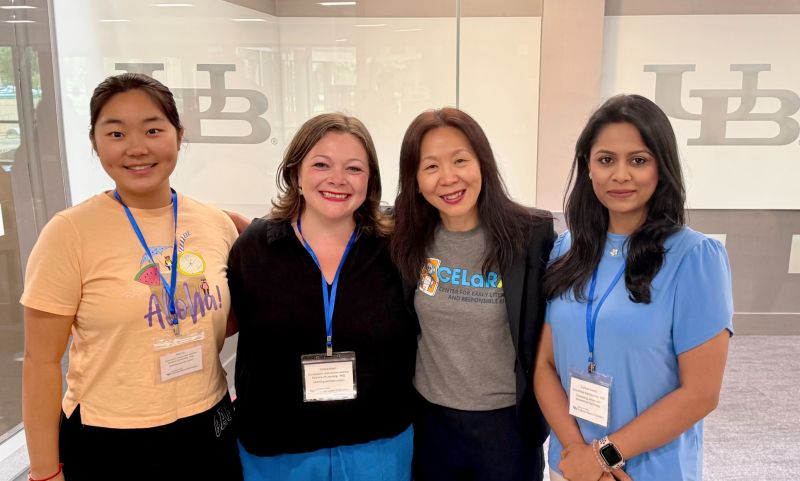
Pictured below are incoming PhD students Celine Krzan, Grace (Yukun) Xu, and Tukhbita Nawmi, alongside our PI Dr. X. Christine Wang at the University at Buffalo Graduate School of Education Welcome Orientation. Their expertise and commitment to equity in education make an enormous impact on our work, and we are grateful for the entire team of student researchers helping to drive CELaRAI forward.
CELaRAI Featured on the “Achieving Joy and Mastery in Public Schools” Podcast
CELaRAI’s leadership and research team joined host Dr. Brian Graham to discuss AI, Literacy, and Equity: How CELaRAI is Shaping the Future of Education at UB. This episode explores how the AI Reading Enhancer (AIRE) can help address the early literacy crisis, empower educators, and ensure equitable access for all learners—while keeping ethics and equity at the forefront of AI in education.
Listen to the full episode on Apple, Spotify, Amazon, or directly on their website:

Introducing CELaRAI – Watch Our Video!
We’re excited to share a brand-new video that introduces the Center for Early Literacy and Responsible AI. This overview explores our mission, our ongoing research, and how we’re leveraging AI thoughtfully to support young readers, educators, and families.

Cover Story: Learn Magazine
While many recognize Artificial Intelligence (AI) as a tool to draft essays or generate images, its potential to transform learning outcomes is only beginning to emerge … Wang is at the center of this movement.
In the spring issue of University at Buffalo Graduate School of Education Learn magazine, Dr. X. Christine Wang is featured as the cover story, “Anything but artificial: X. Christine Wang is personalizing learning with AI” where she shares how CELaRAI is using AI to enhance literacy instruction — tailoring reading materials with the AI Reading Enhancer (AIRE), embedding ethics and equity into every stage of design, and keeping teachers’ and children’s voices at the center.

Research Update: Early Literacy Team Wraps Up Year 1 Exploratory Study with Key Milestones Achieved
Over May & June, the Early Literacy Thrust wrapped up national and local data collection with teachers, students, and school leaders who are the target users of the AIRE tool for CELaRAI’s year one exploratory study. Interviews and focus groups with teachers and school leaders; classroom observations; and one-on-interviews with kindergarten, first-grade, and second-grade (K-2) students have been conducted in partner school districts in New York, Michigan, and North Carolina, and the national teacher survey is now in distribution following expert reviews and cognitive interviews to ensure clarity and validity.
Tanya Christ, Early Literacy Thrust Lead, is currently leading qualitative data analyses to provide insight on the needs of educators and students in these districts. Along with the National Teacher Survey, for which Laura Tortorelli and John Strong will lead quantitative data analyses, these data will provide the foundation for the AIRE tool development and user studies in year 2. In addition, the team conducted another round of development for decodable text and platform rubrics, focusing on rubric use, analysis, and refinement, to aid in the AIRE tool development. To support the study’s broader goals, the Early Literacy Thrust began sharing these resources with the AI, AI Ethics, and Learning Sciences Thrusts at the CELaRAI Kick-Off meeting, focused on reviewing the evidence on digital text features and leading an introduction and practice session on the decodable text rubric, laying a strong foundation for the work ahead!
CELaRAI Kickoff Meeting
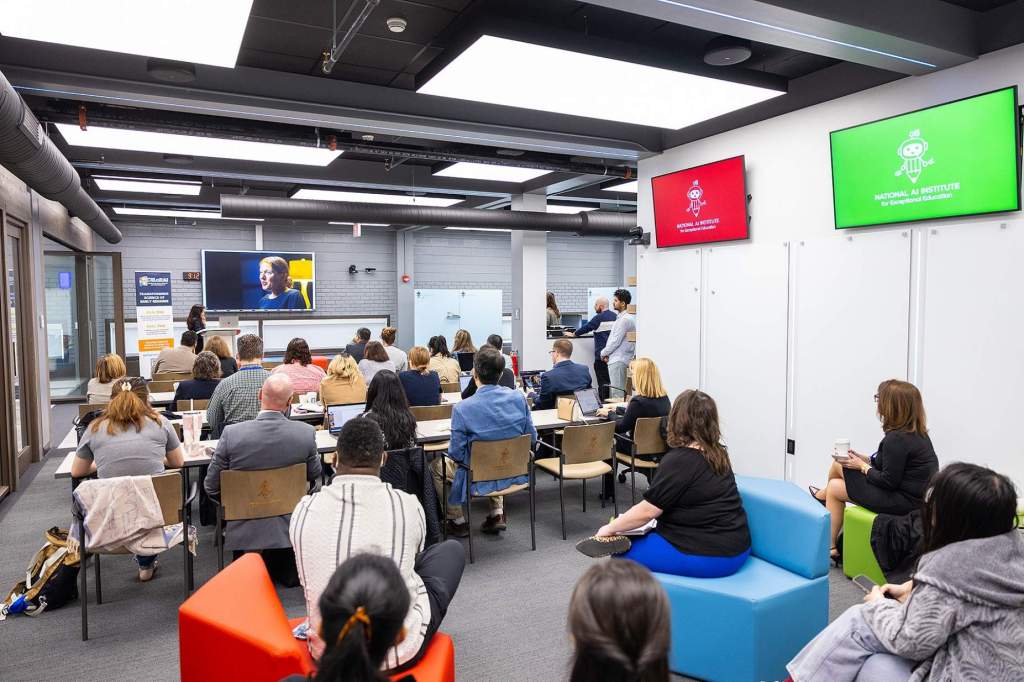
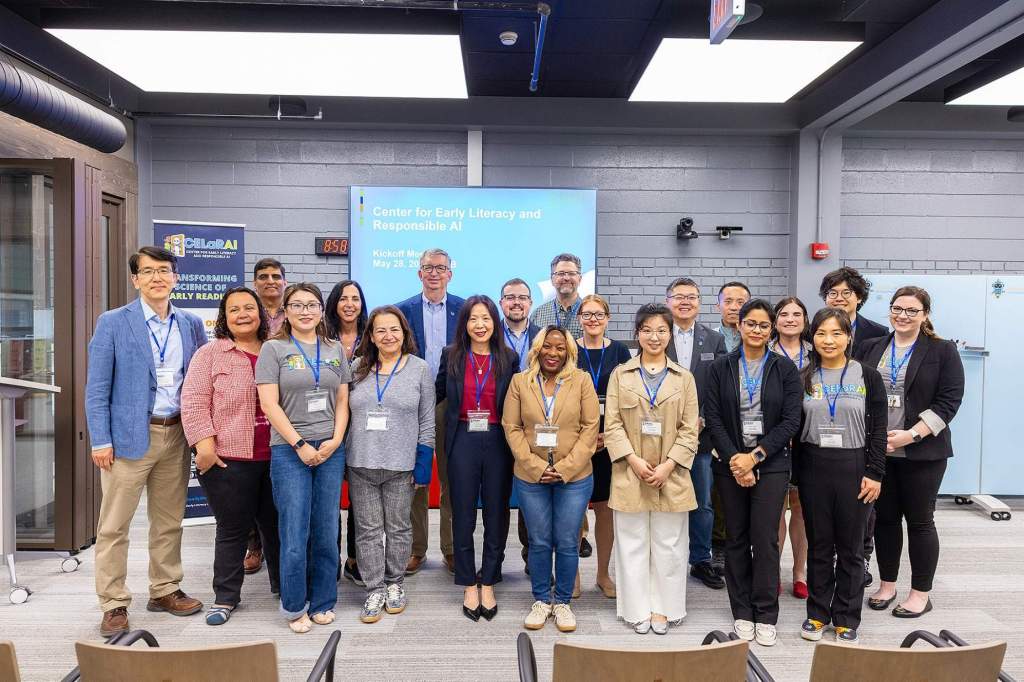
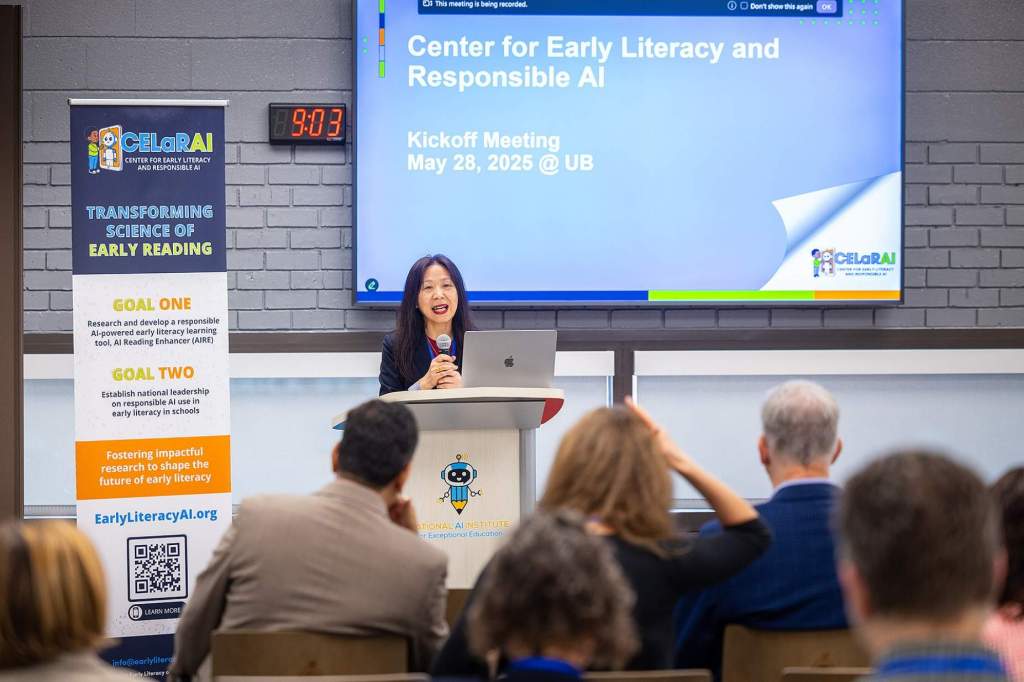
In May, we kicked off the CELaRAI project with a successful three-day launch event that brought together more than 50 researchers, advisors, students, postdocs, school district leaders, and community partners. The program featured a public-facing session and welcoming remarks by the University at Buffalo’s Provost, who emphasized the importance of our collaborative, responsible approach to AI in early literacy. Learn more about this exciting milestone and read the full story on UBNow.

Research Accepted for Presentation at 26th International Conference for Artificial Intelligence in Education (AIED)
We’re proud to share that a paper led by our AI thrust lead and postdocs — Z. Li, Q. Zheng, and J. Xiong — along with F. Xiao, J. Lin, and X. Zou, has been accepted for the 26th International Conference on Artificial Intelligence in Education (AIED) in Palermo, Italy (July 22–26, 2025).
The paper, “StoryLab: Empowering Personalized Learning for Children through Teacher-Guided Multimodal Story Generation,” explores how teacher-guided AI tools can enhance children’s engagement and support personalized learning experiences. Stay tuned for updates as they prepare for the conference!
Public Comments on ED Secretary Priorities
CELaRAI recently submitted a public comment to the U.S. Department of Education in support of their Proposed Priority on Evidence-Based Literacy — highlighting the critical role CELaRAI plays in advancing early reading through responsible AI. Our letter emphasizes how tools like the AI Reading Enhancer (AIRE) align with national priorities to improve reading instruction and support teachers.
Your voice matters too! If you’d like to see this kind of research and innovation continue, we encourage you to advocate for our center’s work. Feel free to use our talking points or share our public comment to help underscore the value of responsible, evidence-based AI in early literacy. Together, we can shape the future of reading instruction.

SUNY AI Symposium
CELaRAI tabled at the SUNY AI Symposium in early April. Our Principal Investigator, Dr. X. Christine Wang, was also featured in the panel “Research Bytes: Meet AI Experts from Across SUNY,” representing AI>Education.


Governor Hochul’s New York 2025 State of the State Video Features UB’s X. Christine Wang
University at Buffalo’s and CELaRAI’s Principal Investigator, X. Christine Wang, was featured in a video presented during Governor Kathy Hochul’s 2025 State of the State address. The video highlights how the Governor’s policies are making a meaningful difference for New Yorkers while showcasing the impactful work of UB’s innovative research. This recognition underscores the role of UB researchers in addressing pressing challenges and driving transformative change across New York State.
UB Awarded $10 Million Grant to Lead New National Center on Early Literacy and Responsible AI
University at Buffalo researchers have been awarded a $10 million grant from the U.S. Department of Education’s Institute of Education Sciences to establish the Center for Early Literacy and Responsible AI (CELaRAI). The Center for Early Literacy and Responsible AI will focus on harnessing the power of artificial intelligence (AI) to transform early literacy instruction for culturally and linguistically diverse learners in kindergarten through second-grade classrooms across the nation, including Buffalo Public Schools and Erie 1 BOCES schools.

Schumer Announces $10 Million for University At Buffalo to Establish New Artificial Intelligence Research Center to Increase Literacy Rates for Students in Western NY and Beyond
Schumer Says New Federally-Funded Center For Early Literacy And Responsible AI Will Help Students Improve Reading Skills Using Cutting-Edge AI Tools. Funding Builds On Senator’s Continued Efforts To Elevate UB As A Leader In AI After Bringing The NSF Director To Campus Earlier This Year & Securing $20M To Create New National AI Research Institute At UB. UB Is Helping Power America’s AI Future!

University at Buffalo Awarded $10 Million Grant to Establish National Center for Early Literacy and Responsible AI
Researchers at the University at Buffalo have been awarded a $10 million grant from the U.S. Department of Education’s Institute of Education Sciences to establish the Center for Early Literacy and Responsible AI (CELaRAI). According to university officials, the Center for Early Literacy and Responsible AI will focus on “harnessing the power of artificial intelligence (AI) to transform early literacy instruction for culturally and linguistically diverse learners in kindergarten through second-grade classrooms across the nation.”